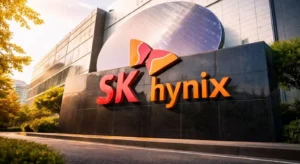

SK Hynix is currently on the verge of making history. The South Korean chipmaker is about to cross the $1 trillion market valuation mark, a feat very few companies in the world have ever achieved. This massive milestone comes just a few weeks after its local rival, Samsung Electronics, crossed the same line. The explosive global demand for artificial intelligence technology has placed South Korea at the center of a massive financial boom that shows no signs of slowing down.
The growth of SK Hynix over the last year and a half is almost hard to believe. Only 16 months ago, the entire company was worth less than $100 billion. Today, it is valued at roughly $948 billion. The stock price skyrocketed by 274% in 2025, and it has already climbed another 200% so far this year. This rapid rise has pushed the company’s value close to traditional American giants like Walmart and Warren Buffett’s investment firm, Berkshire Hathaway.
Investors are pouring money into the company because they realize that AI cannot exist without specialized hardware. SK Hynix produces conventional memory chips, but its real secret weapon is High-Bandwidth Memory, or HBM. These specific chips are essential for the high-power servers that run AI programs. Every time a tech giant like Microsoft or Google spends $1 billion on a new data center, they have to buy thousands of these chips to make the system work.
If SK Hynix successfully joins Samsung in the trillion-dollar club, South Korea will reach a unique global status. It would become the very first country outside of the United States to have more than one company worth $1 trillion. This highlights how the balance of power in the tech world is shifting toward Asian hardware manufacturers. While the American companies design the software, the Korean factories are the ones physically building the brains of the new digital age.
The excitement in the market is palpable. Fabien Yip, a market analyst at IG, says that “FOMO,” or the fear of missing out, is driving many investors to buy as much as they can. This sentiment is visible across both Japan and Korea. While Taiwan’s TSMC remains the biggest player in Asia with a value of over $1.83 trillion, the Korean companies are quickly becoming the most talked-about names on the global stock exchange.
South Korea’s main stock index, known as the KOSPI, has been climbing like a rocket ship. It has hit several record highs recently as both big institutional funds and small individual investors rush to buy chip stocks. The index rose 75% last year and is up more than 86% this year. In fact, since the start of 2025, the KOSPI has been the best-performing major stock market in the entire world. This is its strongest performance since the tech boom of 1999.
On Thursday, the market showed some interesting movements. SK Hynix shares actually dipped slightly by 0.48%. However, this small drop didn’t dampen the mood because Samsung shares rose more than 3% at the same time to hit a brand-new record. The broader market stayed strong, and analysts believe SK Hynix only needs a small push of about 1.5% or 2% in share price to finally reach that $1 trillion goal.
The success of these companies is a direct result of their critical role in the global supply chain. Without a steady supply of HBM and other memory components, the AI industry would grind to a halt. This dependency gives the Korean chipmakers incredible pricing power. As companies race to build smarter bots and faster servers, they are willing to pay a premium for the best hardware, leading to record-breaking earnings for the manufacturers.
Foreign investors are particularly interested in South Korean tech right now. They see the country as a safer and more established bet compared to other emerging markets. The vertical climb of the stock market suggests that people believe this isn’t just a temporary bubble. They think the transition to an AI-driven economy is a permanent shift that will require more and more silicon every year.
Even as competition grows, SK Hynix has managed to maintain a lead in certain high-end memory categories. Their partnership with other industry leaders has solidified their position. As we move through 2026, the race to $1 trillion will likely reach its conclusion very soon. Whether it happens tomorrow or next week, the rise of SK Hynix proves that the world’s most valuable resource is no longer oil or land, but the tiny chips that power our machines.