
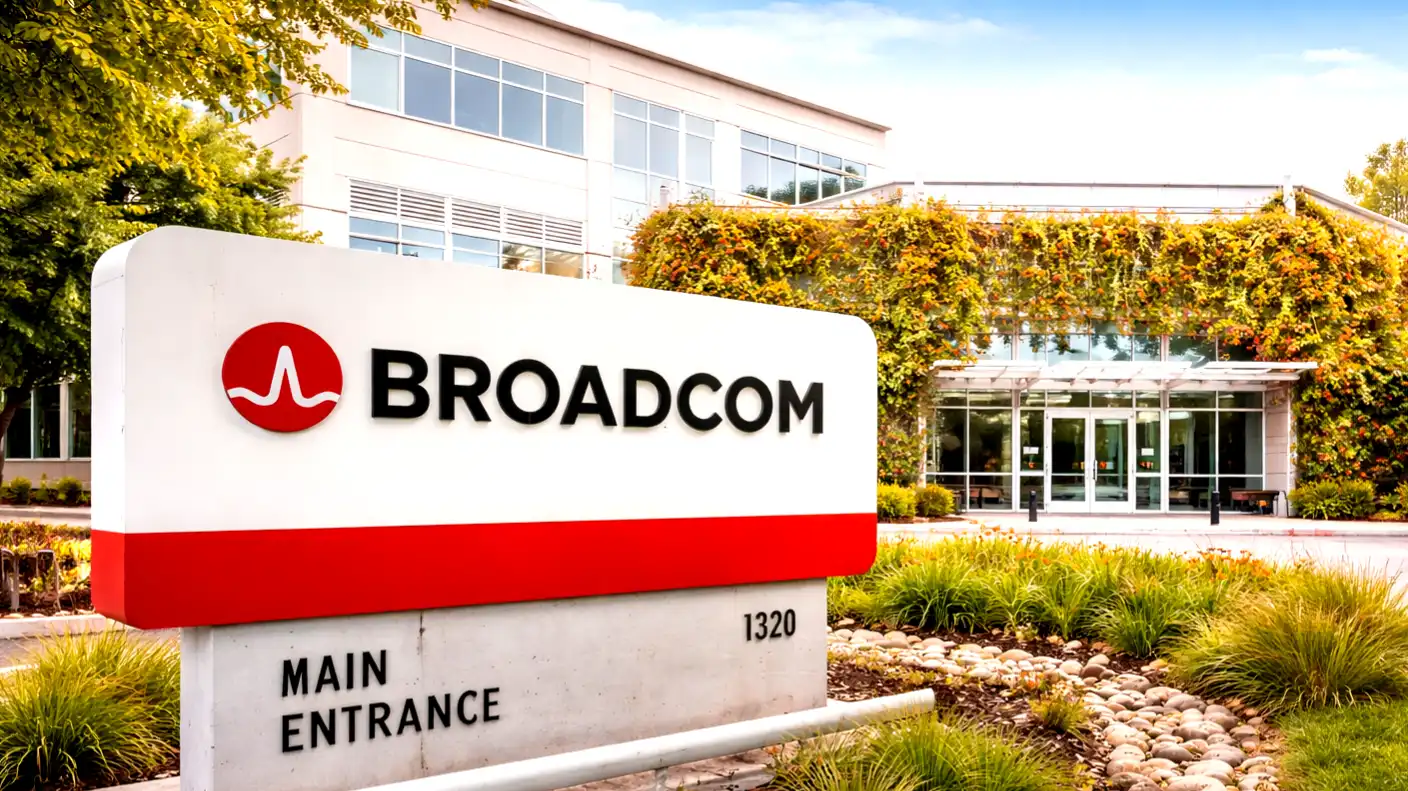
Broadcom has officially set a new standard for the semiconductor industry, issuing a quarterly revenue forecast that comfortably topped Wall Street’s already ambitious expectations. On Tuesday, the networking and software giant revealed that its sales projections for the coming months have outpaced the estimates set by financial analysts, sending a clear signal to the market that the artificial intelligence infrastructure surge is far from over. This strong guidance highlights the critical role Broadcom plays in the modern digital economy, particularly as cloud providers and enterprise data centers spend record amounts of money to upgrade their networking hardware.
The company’s ability to thrive despite a complex global trade environment is a testament to its highly diversified business model. Unlike smaller chip designers that rely on a narrow set of products, Broadcom manages a massive portfolio ranging from high-speed Ethernet switches and optical interconnects to sophisticated custom silicon for data centers. This variety has shielded the firm from the cyclical downturns that often plague specialized hardware makers. By serving as the essential “plumbing” for the internet, Broadcom ensures that every byte of data, whether it is for a simple web search or a complex generative AI model, flows through its proprietary technology.
The demand for AI-related networking hardware has reached a fever pitch. Large-scale data center operators—often referred to as hyperscalers—are currently locked in a race to build the fastest AI clusters on the planet. These clusters require thousands of specialized switches and controllers to move data between GPUs without creating a bottleneck. Broadcom’s recent surge is directly tied to this infrastructure expansion, as the company remains the primary supplier of the high-speed Ethernet chips that allow these massive server racks to function as a single, unified machine.
Financial analysts were quick to praise the company’s forward-looking strategy. The firm is now capturing revenue from multiple “layers” of the AI stack. It sells the hardware that routes the data, the software that manages the traffic, and the custom silicon that allows cloud providers to tailor their data center efficiency. Investors have rewarded this approach, pushing the stock toward record highs as they anticipate further growth. Even a small 1.5% increase in market share within the high-speed networking segment translates into hundreds of millions of dollars in recurring annual profit for the firm.
Broadcom is also benefiting from the “sovereign AI” trend, where nations and large private corporations are investing over $1 billion to build their own independent data centers. These organizations want to keep their data secure and local, and they need hardware that can handle the high-traffic demands of localized AI models. Broadcom’s networking technology has become the gold standard for these deployments, providing the reliability that enterprise clients demand. As these localized clusters multiply across the globe, Broadcom’s position as a key infrastructure provider becomes even more entrenched.
One of the company’s most underrated strengths is its ability to successfully integrate major acquisitions. Over the last several years, Broadcom has bought several software and hardware companies, folding them into its operation while maintaining high margins. This “buy-and-integrate” strategy has given them a unique mix of high-speed hardware and enterprise-level software. For a large business, buying a networking switch from Broadcom often means buying into a suite of tools that helps manage that hardware securely, reducing the need for expensive third-party IT support.
Management at Broadcom has also maintained a disciplined approach to capital expenditure, ensuring that they do not overextend during the current AI frenzy. While many of its competitors are burning through cash to build out massive new fabrication plants, Broadcom relies on a “fab-light” strategy, partnering with foundries like TSMC to handle the actual manufacturing of its chips. This approach lowers the company’s fixed costs, allowing it to maintain an exceptionally healthy profit margin that is the envy of the entire semiconductor sector.
Looking toward the remainder of 2026, the company expects the AI networking segment to grow even faster than the rest of its business. Management hinted that they are already seeing increased interest for 2027, as new server designs move from the testing phase into mass production. This “forward-looking” demand gives the company a level of revenue visibility that most technology firms would die for. Shareholders can expect the company to continue its policy of aggressive share buybacks and steady dividend increases, as it generates more cash than it can effectively reinvest into its own operations.
Despite the optimism, the industry does face significant macroeconomic headwinds. Global trade policies and regional semiconductor export restrictions could still create surprises for companies with international supply chains. However, Broadcom’s leadership appears confident that their products are essential enough to bypass most of the geopolitical friction that currently troubles other firms. They are not just selling chips; they are selling the critical connectivity that keeps the global digital economy functioning.
Ultimately, this latest earnings update proves that Broadcom has moved past its days as a simple legacy component maker. It is now a core pillar of the AI age. As long as the world remains obsessed with training larger, faster, and smarter models, the networking backbone built by this company will be the first thing that gets bought, installed, and powered up. With a track record of beating estimates and a clear view of the industry’s future, Broadcom is not just riding the wave—it is directing where the wave goes.