
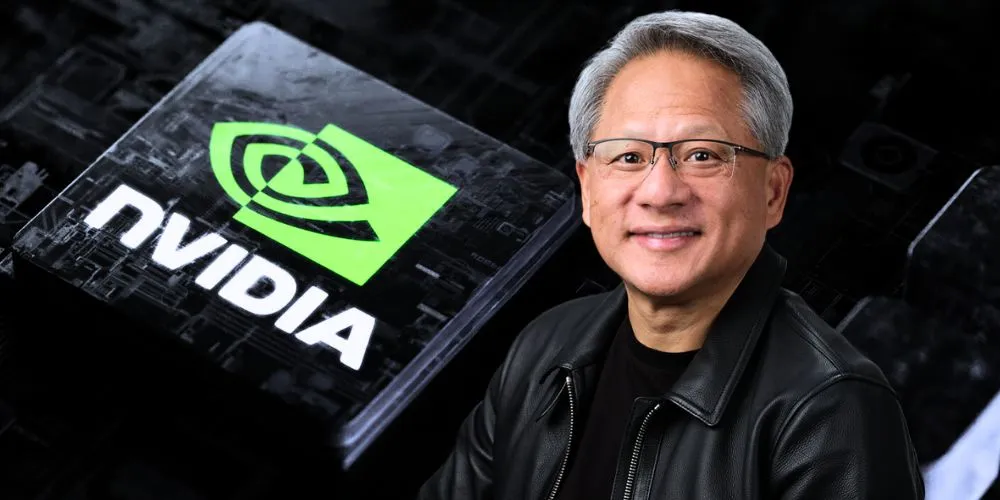
The semiconductor market is undergoing a seismic shift, and investors are finally realizing that Nvidia cannot power the entire artificial intelligence revolution alone. Marvell Technology, a specialized designer of high-speed networking and data center chips, saw its stock price soar this week following an unexpected and glowing endorsement from Nvidia CEO Jensen Huang. During a recent industry summit, Huang identified Marvell as a key player in the “next tier” of AI hardware, effectively predicting that the company has the potential to eventually join the exclusive trillion-dollar valuation club. This public stamp of approval has ignited a massive buying spree, cementing Marvell’s status as a must-have asset for portfolios betting on the future of data infrastructure.
For years, the spotlight remained firmly fixed on the graphics processing units (GPUs) that train AI models. However, the market has reached a point where the physical networking fabric that connects these thousands of GPUs is becoming the primary bottleneck. Marvell builds the specialized silicon that allows these massive server clusters to talk to one another without significant latency. As tech giants continue to pour more than $1 billion every few months into building increasingly complex AI factories, the demand for Marvell’s high-speed Ethernet switches and optical interconnects has grown into a vertical wall of demand.
The financial performance of Marvell reflects this surging interest. In its most recent earnings report, the company showcased double-digit growth in its data center division, driven primarily by the need for low-latency, energy-efficient networking. While standard chips focus on raw computing speed, Marvell focuses on “data movement.” When an AI system performs an inference task, the ability to move massive files across a facility in milliseconds is just as important as the calculation itself. By mastering this transport layer, Marvell has made itself an essential, if often overlooked, partner for every major hyperscaler, including Amazon, Google, and Microsoft.
Jensen Huang’s endorsement carries immense weight because Nvidia itself relies on Marvell’s networking components to ensure its own GPUs function at peak capacity. By calling Marvell a future trillion-dollar company, Huang is acknowledging that the AI ecosystem is a collaborative, rather than purely competitive, environment. It is a rare instance of a dominant leader publicly acknowledging that its own success is inextricably linked to the performance of its partners. This relationship creates a level of stability that institutional investors love, as it suggests that Marvell’s growth is not just speculative, but tied directly to the core infrastructure needs of the biggest companies in the world.
The shift toward custom silicon is another major factor driving Marvell’s valuation. Unlike traditional firms that only sell off-the-shelf parts, Marvell has pivoted toward an “ASIC-first” business model. They work directly with cloud providers to design custom chips that perform specific, highly optimized tasks. This “bespoke” silicon model provides significant advantages, such as improved energy efficiency and lower total cost of ownership. For a data center that consumes enough electricity to power a small city, even a 1.5% improvement in networking efficiency translates to millions of dollars in annual savings on utility bills.
Looking ahead, Marvell is aggressively expanding its portfolio to cover the next generation of AI workloads, including “agentic” AI applications. These systems require even faster response times and more reliable data paths than traditional chatbots. The company is investing heavily in optical interconnects, which use light to move data across much longer distances within the data center, bypassing the traditional physical limits of copper wiring. This technological edge is a key reason why Wall Street analysts are raising their price targets, with some projecting that the company’s revenue could maintain a double-digit growth trajectory through the end of 2027.
The stock’s recent surge is part of a broader trend where the “AI infrastructure” sector is decoupling from the rest of the tech market. While consumer electronics and standard PCs have faced a sluggish year, the infrastructure providers are thriving. This divergence has led many fund managers to pivot their capital away from stagnant consumer hardware and into firms that provide the backbone for AI. Marvell sits comfortably in this high-growth pocket, offering investors a way to bet on AI infrastructure without the extreme price tags often associated with the most popular GPU manufacturers.
Of course, the company faces its share of hurdles. Maintaining a competitive edge in the semiconductor industry is a relentless, expensive game. The company must consistently iterate on its silicon designs, manage the complex global supply chain, and fend off smaller, more agile startups that are constantly trying to disrupt the networking market. However, the current momentum suggests that Marvell is not just surviving the competition; it is actively setting the pace. Its ability to scale production while keeping its margins high provides a level of financial discipline that is often lacking in the high-growth AI space.
As we look toward the final half of 2026, the question is whether Marvell can actually reach the trillion-dollar milestone. Reaching such a height requires not just excellent technology, but also a sustained expansion into new markets like automotive AI, robotics, and industrial automation. The company has already begun showing interest in these areas, hinting that the “AI Factory” concept could extend far beyond the server farm. If they can successfully diversify their revenue while maintaining their networking dominance, the road to a trillion-dollar valuation becomes much clearer.
Ultimately, Marvell’s recent success is a reminder that the AI revolution is a team sport. Nvidia may own the spotlight, but the entire hardware ecosystem—from memory makers to networking architects—is moving in lockstep. By securing a leading role in this ecosystem, Marvell has transformed from a niche semiconductor firm into a cornerstone of the modern digital economy. For investors, the takeaway is simple: the next trillion-dollar winner will likely be a company that makes the entire AI system faster, cheaper, and more efficient for everyone.