
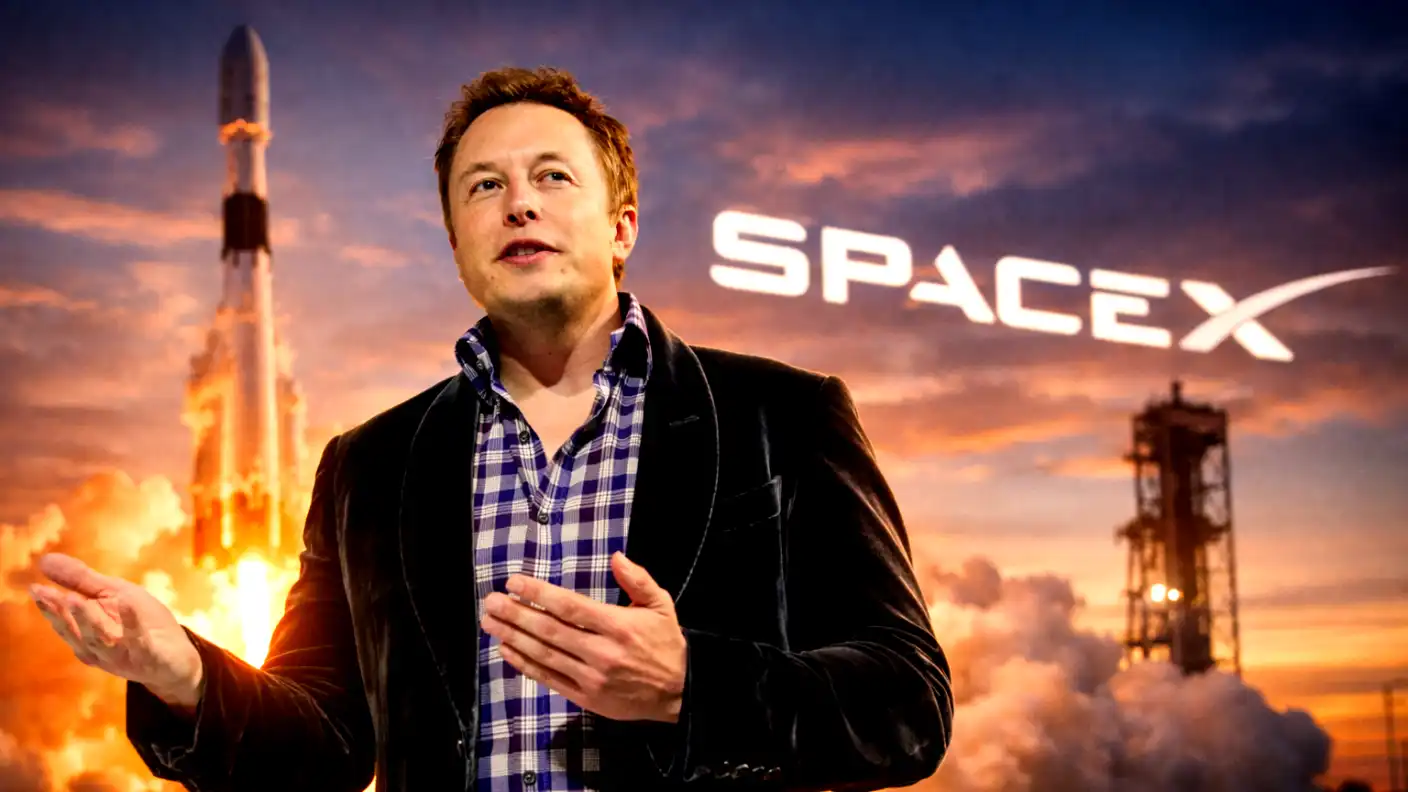
SpaceX is charging ahead with one of the most significant financial maneuvers in corporate history. Elon Musk’s aerospace and AI empire has officially filed its S-1 prospectus with the Securities and Exchange Commission, setting the stage for a public listing on the Nasdaq. If the current momentum holds, the company will trade under the ticker symbol SPCX, inviting global investors to participate in the future of space exploration and satellite internet. While the firm initially pursued a confidential filing process, the recent public disclosure confirms that the transition to a publicly traded entity is well underway.
The financial scope of this offering is monumental. Although SpaceX has not confirmed a final share price, reports indicate the company is eyeing a valuation that could push toward the $1.75 trillion mark. This target represents a massive leap from its private valuations of recent years. If the offering succeeds at this scale, it will shatter the record for the largest public debut in history, significantly outperforming the massive listings seen by tech giants like Facebook and Alibaba during their own early market entries.
Wall Street analysts are already debating how to value such a unique conglomerate. SpaceX does not just build rockets; it operates the world’s largest satellite constellation, provides critical defense logistics, and has integrated advanced artificial intelligence through its xAI merger earlier this year. This “everything” strategy makes the company a complex bet for traditional fund managers. Investors are not just buying into aerospace; they are buying into a multi-layer infrastructure provider that aims to dominate the skies and the digital data markets simultaneously.
The paperwork reveals that the company is currently on a massive spending spree, fueled by the need to scale its “orbital data center” vision. To reach its goal of deploying up to one million satellites, the firm must maintain a launch cadence that dwarfs every other aerospace program in existence. This growth requires billions of dollars in annual capital expenditures. The prospectus notes that the company expects to “incur significant capital expenditures over a period of years” as it builds out its AI-driven orbital infrastructure, signaling to potential buyers that the firm is in a heavy investment phase rather than a harvest phase.
Financial records included in the filing show that the Starlink division has become the company’s most important profit engine. In the most recent quarter, Starlink generated $3.26 billion in revenue, accounting for roughly 69 percent of the total sales for the company. While the core space exploration and AI units are still operating at a loss—reporting deficits of $619 million and $2.5 billion respectively—the Starlink cash flow provides the stability needed to fund these high-risk ventures. This financial structure is a critical detail for investors, as it proves the company has a viable way to pay for its own innovation without relying solely on external debt.
Despite the excitement, the document warns of several significant risk factors. The company admits to a long history of net losses and explicitly states it may not achieve full, consolidated profitability in the near future. Furthermore, the firm is navigating several high-profile investigations, including legal scrutiny over content moderation on its social media platform, X, and allegations regarding the behavior of its Grok AI model. The prospectus warns that these ongoing inquiries could lead to fines, operational restrictions, or damage to the brand’s global reputation.
The leadership structure is equally bold. Elon Musk has insisted on a dual-class share structure for the IPO. This move concentrates voting control directly in his hands, along with other holders of Class B common stock. While this protects Musk’s vision from being derailed by short-term shareholder pressure, it also limits the influence of retail and institutional investors. For a $1 trillion-plus company, this is an unconventional and powerful governance model that ensures Musk remains the sole architect of SpaceX’s direction for decades to come.
Interest from major institutional investors remains sky-high. Reports suggest that financial giants like BlackRock are considering investments ranging from $5 billion to $10 billion for the IPO. This level of support from the world’s most conservative money managers suggests they view SpaceX as a foundational asset for the next era of technology. Even if the broader stock market experiences a minor correction of 1.5% or more in the coming months, the demand for this specific IPO is likely to remain insulated due to the company’s unique role in the global tech ecosystem.
This IPO follows a difficult week for Musk in the legal arena. A California jury recently ruled against him in a lawsuit brought by his former partners at OpenAI. The verdict, which a federal judge immediately adopted, concluded that Musk failed to sue within the legal time limit. While Musk characterized this as a “calendar technicality” and promised an appeal, the loss serves as a reminder of the complex legal environment surrounding his AI ventures. Going public will only bring more legal attention to his companies, as every word uttered by the CEO will now be analyzed for its potential impact on the stock price.
For the average person, the SpaceX IPO is a rare chance to own a piece of the company that arguably did the most to disrupt the space industry. It is a moment where the frontier of the solar system meets the mechanics of the Nasdaq. Whether or not the company hits its $1.75 trillion goal, one thing is certain: the world will be watching the opening bell. If the market receives the offering well, it could set off a new wave of capital investment in space-based AI and infrastructure, making the final quarter of 2026 one of the most consequential periods in the history of global finance.