
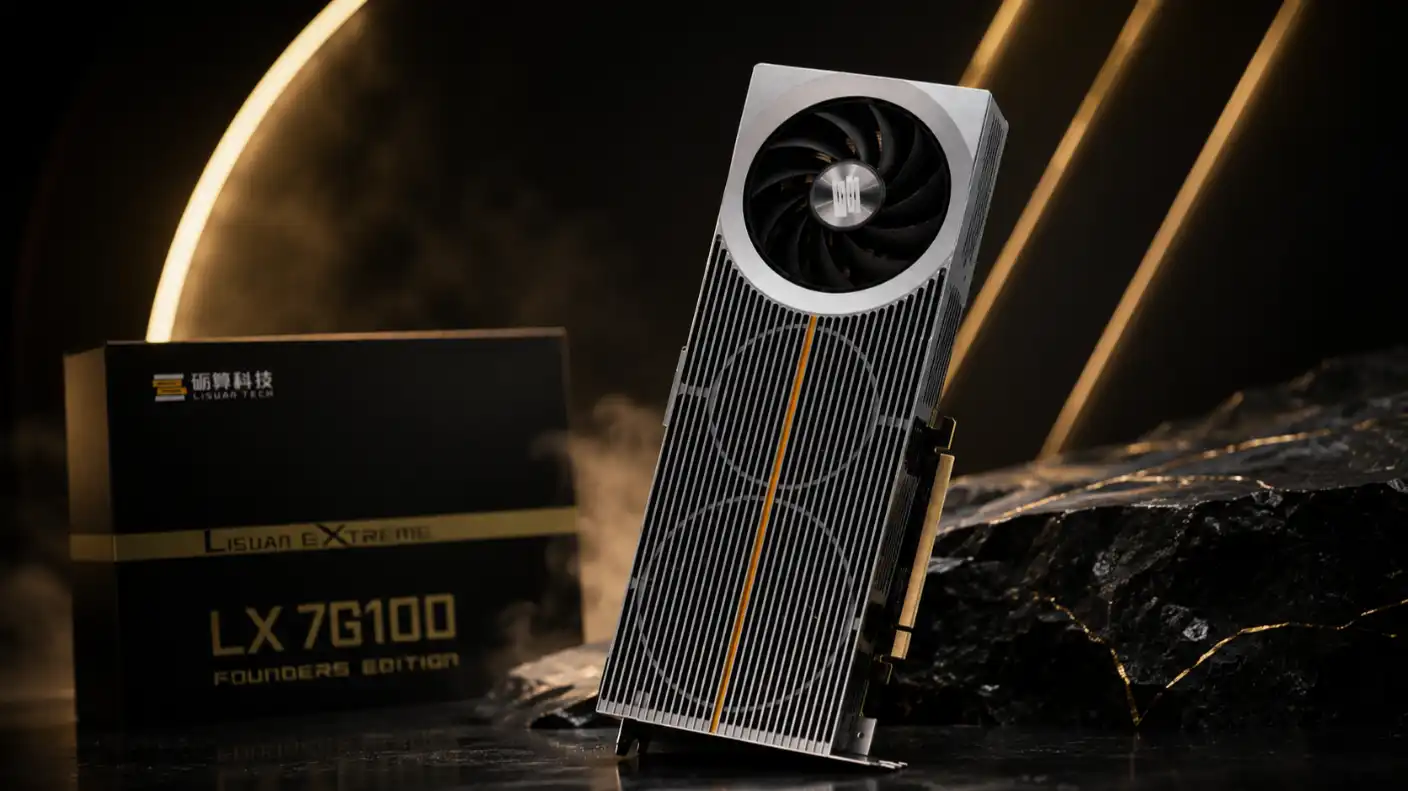
The gaming hardware market just witnessed a bizarre display of brand loyalty and marketing power. A Chinese graphics card manufacturer recently released the LX-7G100, a new consumer GPU that promised a lot but delivered very little in early benchmark tests. Despite reviews describing the card as underwhelming and lacking the raw power of established Western rivals, the company managed to sell out its entire initial inventory of 30,000 units in less than 48 hours. This massive sell-out proves that in the current tech landscape, a strong marketing campaign and a sense of national pride can often trump cold, hard performance data.
The LX-7G100 arrived with high expectations. As China continues its multi-billion-dollar push to become self-sufficient in semiconductor manufacturing, local consumers have begun to rally behind “made-in-China” silicon. This specific card represents one of the latest attempts to bridge the gap between high-end international gaming performance and local production capabilities. However, when independent reviewers finally got their hands on the hardware, they found that the chip struggled to compete with mid-range cards from companies like Nvidia or AMD.
The performance gap was immediately apparent. In standard gaming tests, the LX-7G100 frequently trailed behind budget-friendly cards that hit the market over a year ago. Critics pointed to poor driver optimization and a lack of support for modern ray-tracing features as significant drawbacks. In one test, the card achieved only about 75 percent of the frame rates expected from an equivalently priced international competitor. For many experts, the card felt like a relic from a previous generation, lacking the efficiency and power necessary to drive modern, high-resolution gaming monitors.
Despite these lukewarm reviews, the launch was a massive commercial success. By the time the 48-hour mark rolled around, the manufacturer confirmed that 30,000 units had been snapped up by eager gamers. Social media platforms in China were flooded with posts from fans celebrating the purchase, often citing the importance of supporting local industry over buying imports. For these buyers, owning the LX-7G100 was less about hitting 144 frames per second in 4K resolution and more about participating in a national effort to develop a domestic tech ecosystem.
This phenomenon highlights a growing trend where brand identity and geopolitical alignment influence purchasing decisions more than traditional value-for-money metrics. While an enthusiast in the United States or Europe might demand the best possible performance per dollar spent, a segment of the Chinese market is currently prioritizing domestic origin. This behavior has created a unique “captive” audience that is willing to overlook hardware limitations, effectively giving local manufacturers the breathing room they need to iterate and improve their designs without the immediate threat of market abandonment.
Financial analysts are watching this development with great interest. If Chinese consumers continue to support locally made components regardless of performance, the local GPU industry could eventually mature into a formidable competitor. With the Chinese government pouring over $100 billion into semiconductor development, these companies have the capital to keep refining their architectures. Today’s underperforming GPU might be a disappointment, but tomorrow’s version could easily bridge the remaining 10% to 15% performance gap through better software and refined design.
This surge in sales also reveals the sheer size of the gaming market in East Asia. With millions of active players, even a niche product can move huge volumes if the marketing hits the right notes. By selling 30,000 units in two days, the manufacturer proved that there is enough scale to sustain a local industry, provided they can eventually fix the performance issues. For international companies, this serves as a warning: the dominance of traditional chipmakers may not be guaranteed if local alternatives continue to gain favor and public support.
Of course, the long-term success of this manufacturer will depend on whether they can improve their software stack. Modern graphics cards are complex systems that rely on constant driver updates to run the latest games. If the manufacturer cannot provide the same level of software support as its global rivals, customers will eventually lose interest. A 1.5% drop in system stability is enough to cause frustration for any serious gamer, and the company must prove that it can offer the same polished experience that global players have provided for decades.
Ultimately, the LX-7G100 incident serves as a perfect case study for the current state of the global hardware market. Technology is no longer just about benchmarks and frame rates; it is about identity and supply chain security. As long as there is high demand for affordable gaming hardware and a desire for independence from Western tech monopolies, Chinese makers will continue to find eager customers. The challenge now is to take that enthusiasm and turn it into actual engineering excellence. Until then, these cards remain a triumph of branding over raw computing power.