
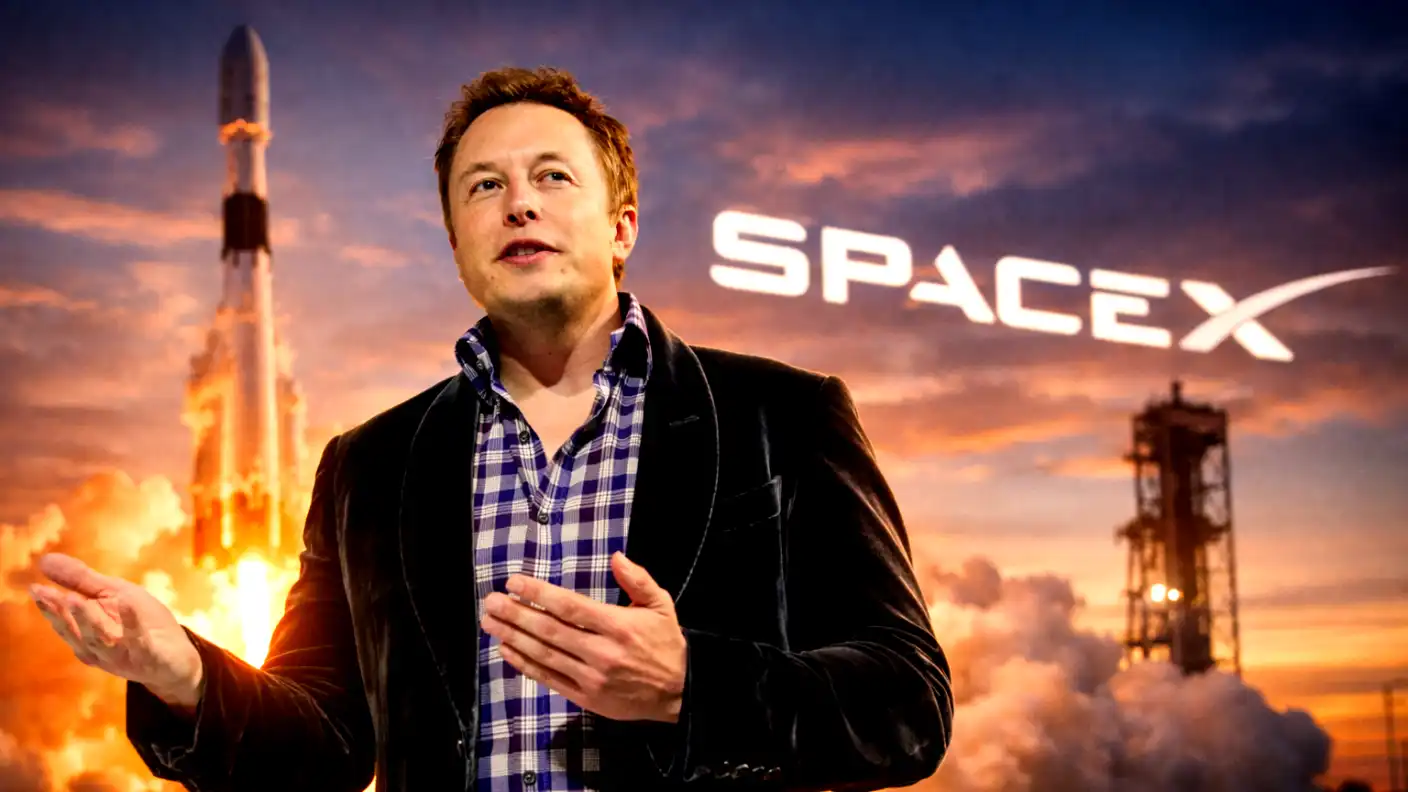
SpaceX just cleared a major hurdle on its path to the public markets. Following a successful flight test of the Starship V3 rocket, the aerospace firm is now shifting its focus from engineering triumphs to financial disclosure. With the company’s first public prospectus expected to land on desks at the Securities and Exchange Commission later this week, investors are preparing for what will likely be the most significant initial public offering in the history of the Nasdaq exchange. The successful launch demonstrated that the massive rocket system is no longer just a prototype; it is a viable transportation platform that can turn Elon Musk’s ambitious dreams into a profitable business reality.
The timing of this test flight could not have been better for Musk. By proving that Starship can deliver heavy payloads to orbit in a fully reusable configuration, SpaceX has provided the exact evidence that institutional investors were demanding. For months, Wall Street has watched the company’s private valuation climb to an estimated $1.25 trillion. Now, the successful deployment of Starship provides the tangible proof needed to justify that figure to the public. If the company maintains this momentum, SpaceX could become the first aerospace firm to hold a trillion-dollar market cap on its first day of trading.
Financially, SpaceX operates on a scale that defies traditional aerospace comparisons. The company has poured more than $15 billion into the Starship program, a massive capital expenditure that serves as the foundation for its long-term growth. Last year, the space segment alone generated $4.1 billion in revenue, though it still posted an operating loss of $657 million as the company finalized its engine technology. However, the Starlink connectivity division has turned a corner, bringing in $11.4 billion in sales and $4.4 billion in operating income during 2025. This profitability from satellite internet is what allows the company to absorb the heavy losses associated with rocket development.
The transition from a private startup to a public giant brings new responsibilities. Once the IPO concludes, SpaceX will face quarterly audits and intense pressure to show consistent earnings growth. Market analysts expect the company to push for a rapid launch cadence, targeting dozens of flights per year. Each successful Starship launch creates an opportunity to drop the cost of reaching orbit by a significant margin. If the company can capture even 1.5% of the total global logistics market for orbital freight, it will secure a revenue stream that could sustain its operations for decades.
Musk’s vision for the company extends far beyond simply launching satellites for private customers. The business roadmap includes the ambitious “orbital data center” initiative, which recently secured a $1.25 billion contract from Anthropic. This project involves launching a large constellation of satellites capable of performing AI inference in space, bypassing the energy and land constraints that currently limit data center expansion on Earth. The successful Starship test ensures that SpaceX has the heavy-lift vehicle required to build this constellation at scale, turning the company into a critical layer of the global AI stack.
Despite the recent success, significant regulatory and operational hurdles remain. The company’s prospectus highlights the need for spectrum authorizations, orbital debris mitigation approvals, and international regulatory clearance for its planned constellation of one million satellites. These are not merely administrative tasks; they represent complex, multi-year negotiations with governments across the globe. Investors should understand that while the rocket technology is now proven, the legal and geopolitical landscape is far more unpredictable.
The competitive landscape for SpaceX is also becoming more crowded. While no other company currently offers a launch vehicle with Starship’s capacity, several well-funded rivals are developing heavy-lift rockets. These competitors are looking for any sign of weakness in the SpaceX launch schedule to steal market share. However, the company’s ability to reuse the first stage of its rockets—and now, to recover Starship as well—gives it a massive cost advantage. By essentially recycling its hardware, SpaceX can undercut the launch prices of legacy aerospace firms, making it the most attractive choice for government and commercial contracts.
The human element of this mission remains central to Musk’s long-term plan. NASA has already signed on for the Artemis IV mission in 2028, where Starship will serve as the lander to carry the next generation of American astronauts to the moon. This contract is worth billions, but it is also a huge vote of confidence. If Starship can safely carry humans, it transforms the rocket from a cargo ship into a piece of critical national infrastructure. This transition is essential for the company to justify its massive private valuation to public market investors who may be skeptical of aerospace risk.
For potential shareholders, the upcoming IPO represents a bet on the “Musk-era” of space. It is an investment in the idea that humans will soon live and work on multiple planets, and that the infrastructure to get us there can be built at a profit. With $1 billion-plus cash flows coming from Starlink, the company is finally in a position where its “moonshot” projects are funded by its own success rather than relying entirely on outside capital. This financial independence is what sets SpaceX apart from almost every other startup in the aerospace industry today.
As the June 12 listing date approaches, the excitement is palpable. The company has moved beyond the “R&D-only” phase and is now a functioning logistics provider with a clear, commercial path forward. Whether or not it manages to sustain this performance once the stock begins trading will be the true test of the SpaceX business model. For now, however, the successful launch of Starship V3 has confirmed that the rocket giant is ready for the public markets, and the race to define the future of space-based AI is officially underway.