
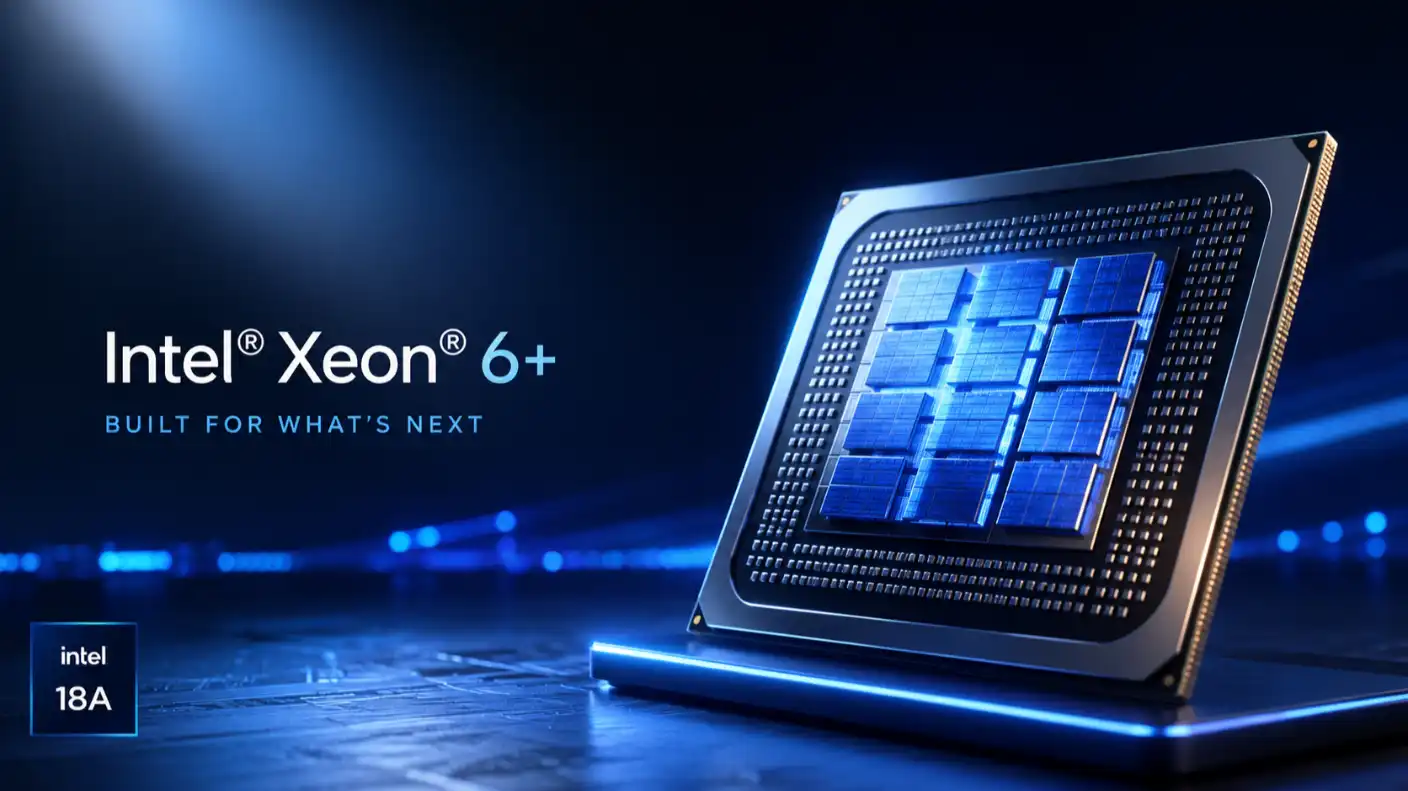
Intel has officially entered the next phase of its data center dominance with the launch of the Clearwater Forest “Xeon 6+” processor family. These chips represent the most significant leap in server hardware from the company in years. By utilizing Intel’s advanced 18A manufacturing process, these processors offer a massive upgrade in core density and power efficiency. With a flagship model boasting 288 cores, Intel is making it clear that it intends to reclaim the top spot in the highly competitive AI and cloud infrastructure market.
The Clearwater Forest lineup is built specifically for the most demanding workloads. While previous generations were focused on general-purpose computing, the Xeon 6+ series targets the specific needs of modern 6G networking and large-scale Edge AI. These sectors require processors that can handle billions of calculations while maintaining low power draw and high reliability. The release comes at a critical time, as tech giants and hyperscalers continue to spend over $1 billion every few months to build out data centers that can keep pace with the ongoing artificial intelligence revolution.
Intel managed to achieve these record-breaking specs by combining four of its most advanced proprietary technologies: RibbonFET, PowerVia, Foveros Direct 3D, and EMIB 2.5D packaging. RibbonFET provides superior electrical control at the smallest scale, while PowerVia rearranges the chip’s power delivery to the back of the wafer, freeing up the front for faster signaling. Foveros Direct 3D and EMIB 2.5D handle the complex task of stacking multiple compute chiplets together. This “holistic” approach allows Intel to pack 12 compute chiplets into a single package, creating a processor that is as dense as it is efficient.
The performance metrics released by Intel are nothing short of transformative. In internal testing conducted alongside infrastructure partners like Ericsson, a single 288-core Xeon 6990E+ processor outperformed a dual-socket system running the previous 288-core Sierra Forest platform. Despite having the same core count, the new Clearwater Forest chip delivered 30 percent higher overall performance. Even more impressive for data center operators, the new design achieved a 38 percent reduction in rack-level power usage and a 60 percent improvement in performance-per-watt. For a company managing 50,000 servers, these efficiency gains translate to millions of dollars in saved electricity every single year.
Memory bandwidth is another area where Intel has made a decisive move. The new platform supports up to 12-channel DDR5 memory, with speeds reaching an incredible 8000 MT/s. When running large language models, the primary bottleneck is often the speed at which data travels between the CPU and the memory modules. By providing 12 channels of high-speed DDR5, Intel ensures that the 288 cores are never starved for data. This is a massive upgrade over older generations, and it ensures the system stays responsive even when training massive models.
Connectivity has also received a massive overhaul. The platform supports 96 lanes of PCIe Gen 5.0 and 64 lanes of CXL 2.0. These high-speed lanes allow data center architects to attach massive amounts of NVMe storage and high-speed AI accelerators directly to the CPU. In the world of enterprise networking, the ability to support this many lanes means that a single Xeon 6+ server can replace a much larger rack of older, slower equipment. This “consolidation effect” is what many large corporations are looking for as they try to save on physical data center space.
Intel’s decision to commit its 18A manufacturing process to the Xeon 6+ family is a major “do-or-die” moment for the company’s foundry ambitions. For years, critics questioned whether Intel could keep its manufacturing schedule aligned with its design teams. By delivering the Clearwater Forest line on time and at scale, Intel proves that its foundry division is finally ready to compete with global leaders. This is a vital step in their effort to convince partners that they are once again a reliable source for world-class silicon.
The software support for these chips is just as robust as the hardware. The company updated its oneAPI Toolkit to ensure that every compiler, library, and AI framework is ready to run on the new architecture from day one. Instead of forcing developers to struggle with new environments, Intel provides a unified software stack that works across its Xeon server chips, Core Ultra laptop processors, and Arc graphics hardware. This “write once, run anywhere” strategy is intended to make it incredibly easy for enterprise customers to upgrade their legacy systems to the new Xeon 6+ platform.
As the company looks toward the next few years, the momentum seems to be shifting. Intel has already announced the successor to this family, the “Diamond Rapids” P-core line, which will scale up to 512 cores per socket for the most extreme AI workloads. With a clear roadmap laid out, Intel is showing that it has a long-term plan for every segment of the compute market, from power-efficient E-core designs to high-performance P-core monsters.
The competition in the server market has reached an all-time high. AMD and other rivals are also pushing out aggressive hardware updates, ensuring that customers have plenty of options. However, Intel’s combination of massive core counts, record-breaking memory bandwidth, and 18A manufacturing efficiency makes the Xeon 6+ family a very strong contender. If the early performance gains in enterprise data centers hold up during the next few months of deployment, Intel may finally have the firepower it needs to stop the bleeding and regain its former status in the high-performance computing market.