
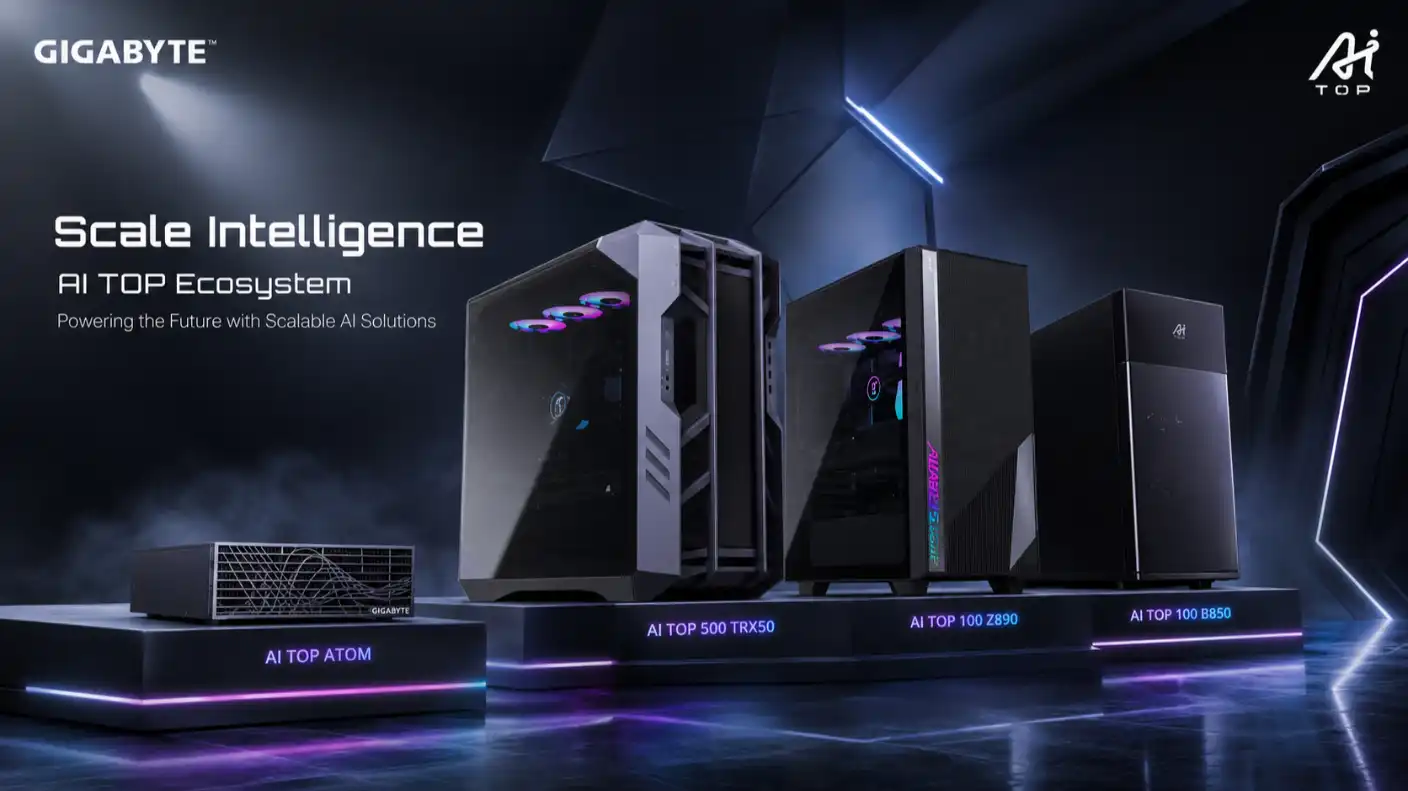
Gigabyte just unveiled a powerful new desktop ecosystem called “AI Top,” designed to bring massive artificial intelligence capabilities directly to the desks of developers and creative professionals. The flagship of this lineup is the Radeon AI Pro R9700 workstation, a machine engineered to run large language models (LLMs) with over 300 billion parameters locally. By moving AI workloads away from expensive, monthly cloud subscriptions and onto a physical desktop, Gigabyte hopes to provide a cost-effective, private, and high-performance solution for the next generation of AI development.
The AI Top ecosystem is not just a single computer; it is a full hardware platform that emphasizes local computing power. The crown jewel, the Radeon AI Pro R9700, features a unique memory and processor architecture that allows it to hold massive datasets in local memory. In an industry where major cloud providers spend over $1 billion every few months to build server farms, this desktop solution offers a compelling “local-first” alternative. Developers can now train and test their proprietary models without worrying about data privacy or the recurring monthly costs associated with public cloud platforms.
One of the most impressive technical aspects of the R9700 workstation is how it manages the massive memory requirements of modern AI models. Loading a 300-billion-parameter model usually requires a massive server rack filled with multiple GPUs. Gigabyte’s engineers optimized the workstation’s internal bus architecture and integrated specialized memory controllers to manage this data locally. This efficiency allows individual researchers to perform complex AI tasks that were, until recently, strictly reserved for companies with enterprise-grade data center infrastructure.
The workstation also includes a highly advanced thermal management system. When you push a processor to handle 300B+ parameter models, it generates extreme heat. Gigabyte utilized liquid-cooling loops and custom-milled aluminum heatsinks to ensure the system remains stable during long, multi-day training runs. For professional users who need their machines to stay running at peak performance 24 hours a day, this cooling focus is a major selling point. It prevents the system from slowing down, ensuring the AI model doesn’t suffer from thermal throttling during the final stages of a model’s training.
The AI Top ecosystem is not just about the hardware specs; it is also about the software integration. Gigabyte is launching the platform with a dedicated “AI Top” software suite that simplifies the process of downloading, configuring, and testing various open-source models. The software acts as a launchpad, allowing users to move from “zero to hero” in minutes. By removing the technical headache of installing complex AI libraries, the company is opening the door for software developers who are not experts in infrastructure to start working with large language models immediately.
This ecosystem approach is crucial for developers who want to avoid the “closed” nature of some AI platforms. Many popular models are increasingly restricted by the cloud providers that host them. By running these models on an AI Top workstation, developers keep full control of their data, their model weights, and their specific research goals. This privacy-focused strategy is already winning over users in industries like healthcare, law, and finance, where data security is a requirement rather than an option.
The potential for cost savings is enormous. Companies that currently pay thousands of dollars every month for GPU cloud instances could see the R9700 workstation pay for itself in less than a year. While the upfront investment is significant, it quickly becomes a bargain when compared to the escalating hourly rates of public cloud computing. For a developer or a small startup, moving to a local workstation can represent a major improvement in their budget management, allowing them to reinvest those funds into more research or human talent.
Competition in the AI desktop space is heating up rapidly. AMD is pushing its Radeon architecture to handle these tasks more aggressively, while Nvidia’s consumer cards struggle with memory capacity for these massive models. Gigabyte’s decision to build a specialized workstation around the Radeon AI Pro R9700 puts them in a unique position. They aren’t just selling a standard PC; they are selling a professional tool designed to compete with enterprise server hardware.
This hardware release is part of a larger trend where AI development is becoming more decentralized. We are shifting away from a world where only massive companies can participate in the AI revolution. By democratizing the hardware needed to run these massive models, Gigabyte is helping to foster a more diverse community of independent AI researchers. Even if a startup captures just 1.5% of the AI development market, they could end up building the most impactful applications of the coming years.
The workstation will arrive in the third quarter of 2026. As we get closer to the launch, we expect to see independent benchmarks comparing this setup against traditional data center GPUs. If Gigabyte’s R9700 performs as advertised, it could quickly become the standard workstation for the burgeoning “home AI” movement. It is a bold product that highlights the changing nature of work, proving that with enough engineering ingenuity, the future of AI can be built right in your own office.