
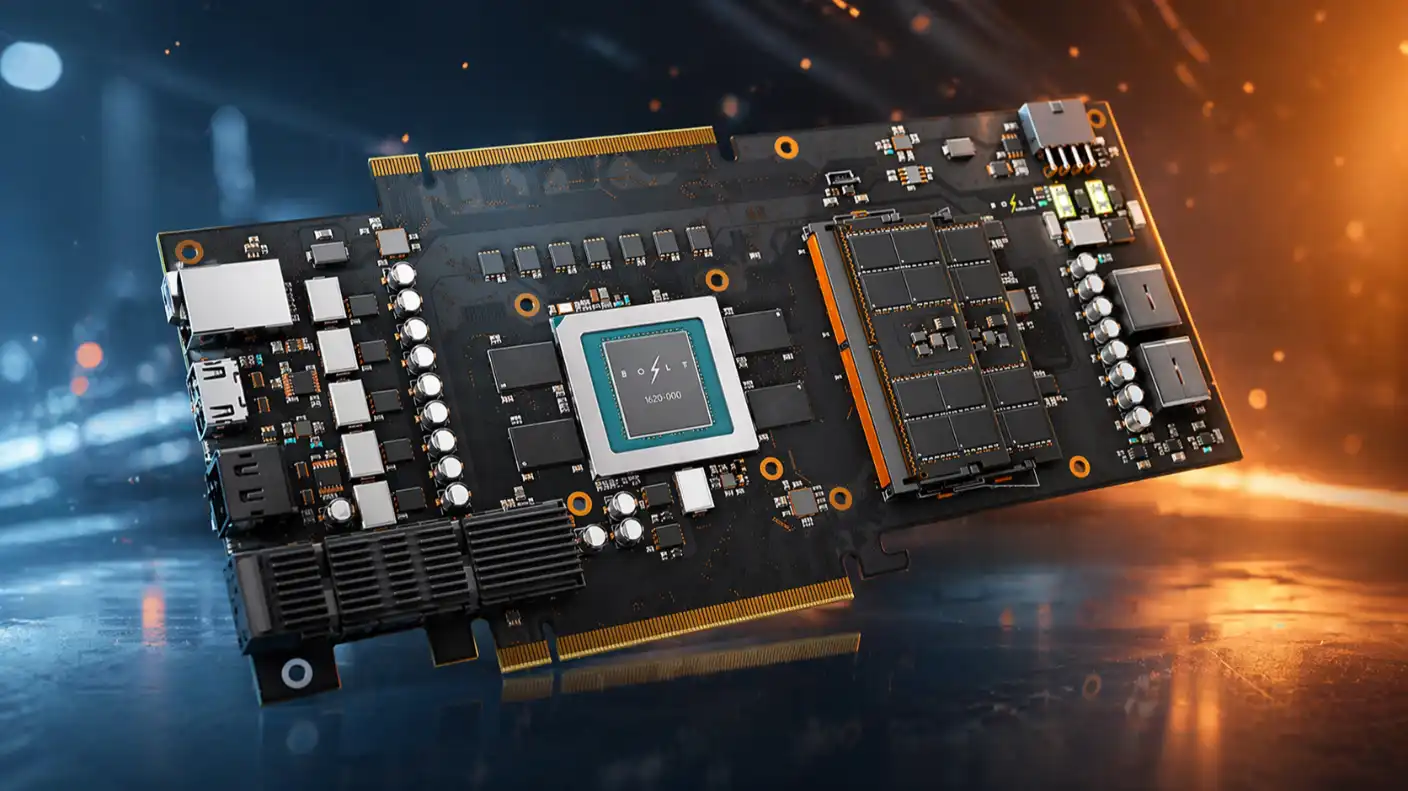
Bolt Graphics recently achieved a major milestone in the computer hardware industry. The tech company successfully taped out its new Zeus graphics processing unit. Engineers built this test chip using TSMC’s 12-nanometer manufacturing process. Last year, Bolt Graphics made some bold promises about this chip, and now they have physical proof that the technology works. The company expects the Zeus chip to deliver massive performance gains over competing hardware. They claim it runs path tracing workloads exactly 5 times faster than the popular NVIDIA RTX 5090 graphics card.
For the last 4 years, customers have tested the Zeus architecture on specialized circuit boards. Bolt Graphics chose to create a unique graphics chip design to target more than just PC gaming. Instead, they built this hardware specifically for heavy workloads like artificial intelligence and high-performance computing. The engineering team focused heavily on saving money and electricity. They wanted to deliver extreme processing power without demanding too much rack space in a data center or burning too much expensive electricity. While the first test chips use a 12-nanometer process, the company designed the core architecture to scale to advanced 5-nanometer nodes in the future easily.
When Bolt Graphics finally launches Zeus, customers can buy the hardware in 2 main form factors. Buyers can choose between standard computer expansion cards and massive server setups. The company plans to release 3 specific models. The entry-level option features a single chip and is codenamed Bolt Zeus 1c26. This card fits into a single computer slot and consumes only 120 watts of power. It packs 32 gigabytes of built-in memory and features 128 megabytes of internal cache. Users can add even more memory using 2 separate memory slots located on the board itself, reaching up to 160 gigabytes.
The middle option significantly steps up the computing power. This dual-chiplet model, named Bolt Zeus 2c26, requires 2 computer slots and pulls up to 250 watts of electricity from the power supply. It doubles the internal cache to 256 megabytes and offers between 64 and 128 gigabytes of built-in memory. Users can expand this memory even further by utilizing 4 extra memory slots. This powerful card hits exactly 40 teraflops of performance for certain computing tasks. It also delivers 154 gigarays of path tracing performance, handling complex visual graphics workloads with absolute ease.
For massive enterprise customers, Bolt Graphics offers the ultimate Zeus server configuration. This huge machine packs an unbelievable amount of hardware into a single server box. The system features up to 2 gigabytes of internal chip cache and a stunning 1 terabyte of high-speed memory. The machine can handle up to 9216 gigabytes of total system memory running at 5.8 terabytes per second. It also delivers an incredible 1228 gigarays of path-tracing capability. This server easily crushes the hardest rendering and data simulation jobs on the market today.
Bolt Graphics confidently compares its new hardware directly against NVIDIA. The company ran internal tests comparing a 250-watt dual-chiplet Zeus card against a 575-watt NVIDIA RTX 5090. The results look very impressive. The Zeus card completed complex path tracing tasks exactly 5 times faster while using less than half the electricity. In general computing tasks, the new chip achieved a 6 times performance boost. The biggest victory came during electromagnetic wave simulations, where a 4-chip Zeus setup ran a massive 300 times faster than a single RTX 5090 graphics card.
The secret behind these huge cost savings comes down to clever memory choices. NVIDIA relies on very expensive graphics memory for its premium data center cards. Bolt Graphics chose to use cheaper, standard computer memory options for the entire Zeus platform. Because of this smart design choice, the Zeus server offers 19 times more memory capacity than the NVIDIA Blackwell system while keeping total ownership costs exactly 17 times lower. Tech buyers will need to wait a little while longer to get their hands on these chips. Bolt Graphics expects to start mass production and ship the final products by the end of 2027.