
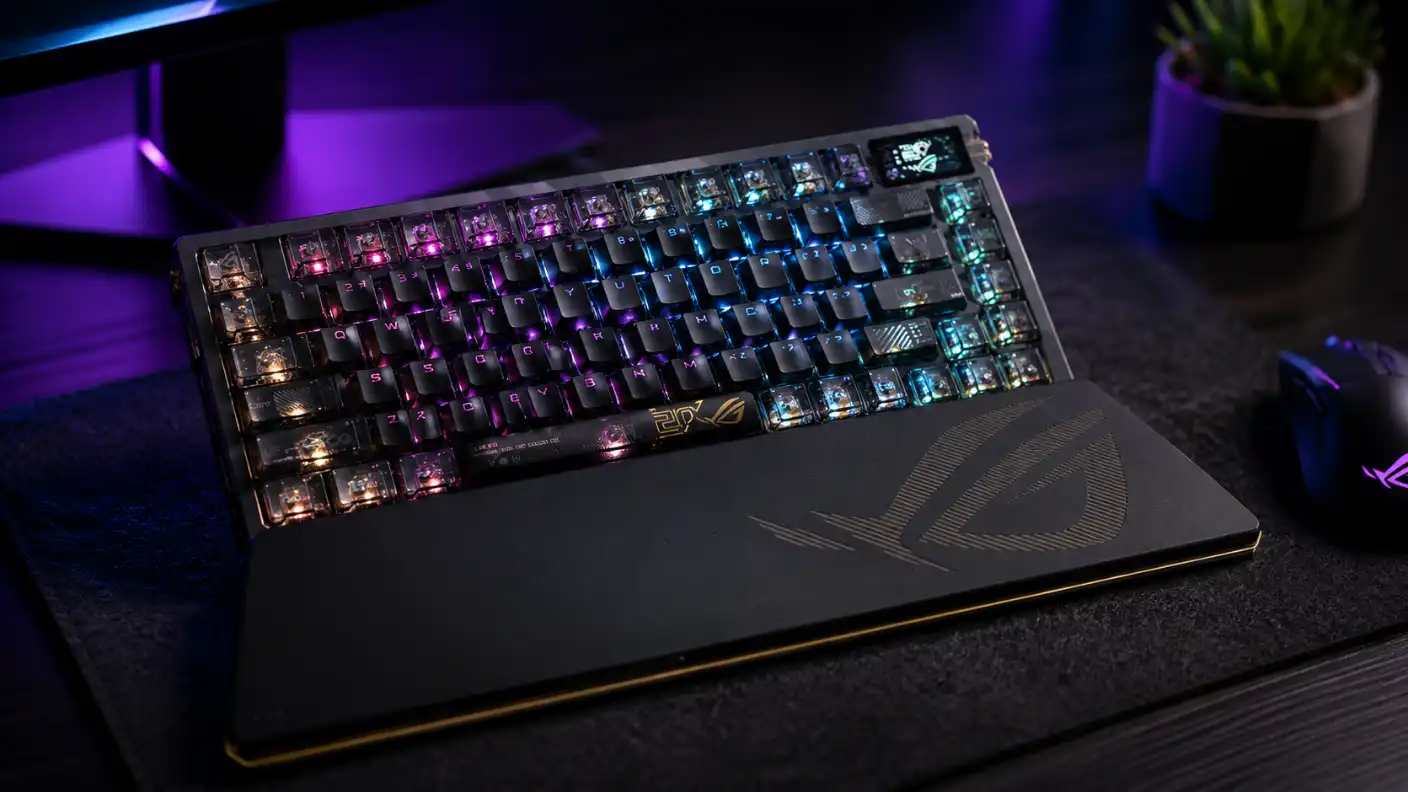
The mechanical keyboard market has witnessed a massive surge in innovation lately, but few products generate as much excitement as the new Asus ROG Azoth Extreme. Following the success of the original Azoth, this “Extreme” edition pushes the boundaries of what a pre-built gaming keyboard can be. With a premium price tag and an build quality that feels more like a piece of fine machinery than a computer peripheral, Asus is clearly targeting enthusiasts who demand perfection. After spending time with the device, it is easy to see that this board isn’t just about flashy lights; it is about changing how we feel about every single keystroke.
The first thing you notice when unboxing the Azoth Extreme is the sheer heft of the chassis. Most gaming keyboards use plastic frames that flex under pressure, but Asus opted for a solid, CNC-milled aluminum base that feels incredibly sturdy. This build quality gives the board a satisfying “thock” sound that mechanical keyboard fans crave. In a market where companies often cut costs by 1.5% to 2% to protect their bottom lines, Asus decided to go in the opposite direction, packing the board with premium dampening foam, silicone gaskets, and a high-quality aluminum plate to ensure the typing feel is as quiet as it is precise.
One of the standout features of this board is its integrated OLED touch display. While many high-end keyboards have added small screens to show battery life or simple logos, the Azoth Extreme takes it further. The screen allows users to adjust system settings, monitor CPU temperatures, or check media information without ever leaving their game. For gamers who use a single monitor and don’t want to Alt-Tab out of their session to see if their fan curves are working correctly, this screen provides a perfect, out-of-the-way glance at their system health.
Customization is at the heart of the “Extreme” experience. The keyboard is fully hot-swappable, meaning you can pop out the switches and replace them with your own favorite tactile, linear, or clicky options without needing a soldering iron. Asus includes a high-end tool kit in the box, which is a great touch for beginners who are just starting to explore the hobby of custom keyboards. Whether you want to dampen the sound for an office environment or make it as loud and clicky as possible for a solo gaming session, the board adapts to your specific needs within minutes.
Performance in gaming is where the board truly justifies its existence. It features a rapid 8,000 Hz polling rate, which sends data to your PC significantly faster than standard gaming keyboards. While the average user might not feel the difference, competitive players who rely on precise timing in fast-paced shooters will appreciate the lower latency. When combined with the high-quality switches included in the kit, the board feels responsive, snappy, and entirely free of the mushy feedback found on cheaper alternatives.
The connectivity options are also top-notch, offering a “triple-mode” experience. You can connect the board wirelessly using a dedicated 2.4 GHz USB dongle for zero-lag gaming, via Bluetooth for your tablet or laptop, or through a standard wired USB-C connection. The battery life is impressive as well; with the OLED screen and RGB lighting active, the board can last for several days of heavy use. If you turn off the flashy lights, that number extends significantly, ensuring you don’t have to keep a cable plugged in during your entire gaming weekend.
Asus has clearly studied the custom mechanical keyboard scene. By adopting a “gasket-mounted” design, the keyboard provides a slight amount of flex when you type. This prevents the fingers from feeling “jarred” when hitting the bottom of the switch, which reduces fatigue during long typing sessions. It is the kind of detail usually reserved for boutique keyboards that cost over $500, but Asus managed to bring it into the mainstream gaming space.
The software utility, Armoury Crate, acts as the command center for this hardware. While some users have historically found the software suite a bit heavy, it does offer an incredible amount of control over the keyboard’s behavior. You can reprogram every single key, set up complex macros, and customize the RGB lighting patterns to match your existing setup. It is a powerful tool for power users who like to fine-tune every aspect of their computer’s interface.
Of course, a board this sophisticated does not come cheap. The market for enthusiast peripherals is growing, with some analysts expecting the sector to generate well over $1 billion in global sales this year. While the price might make casual buyers pause, the target audience for the Azoth Extreme isn’t the average office worker. It is for the person who spends eight hours a day at their desk and wants a tool that is as reliable as a high-end camera or a professional-grade microphone.
It is rare to see a product that feels like the “endgame” for a specific category, but the ROG Azoth Extreme comes very close. It takes the best parts of the custom keyboard hobby—aluminum builds, gasket mounting, and hot-swappable switches—and blends them with the speed and software support of a major gaming brand. If you want a keyboard that is built to survive a decade of heavy use and offers one of the best typing sounds available today, this is an excellent choice.
While there are certainly cheaper options on the market, the attention to detail here sets a new bar for what we should expect from high-end gaming gear. By focusing on the “feel” and the “sound” of the typing experience, Asus has shown that a gaming keyboard can be a luxury item. It is a fantastic piece of technology that proves gamers are willing to invest in their setup when the quality matches the price.