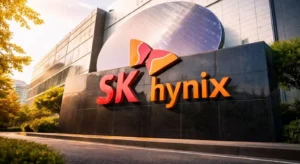

South Korea’s chip manufacturing sector is currently experiencing a historic financial surge, with SK Hynix positioned on the verge of crossing the prestigious $1 trillion market value mark. This potential milestone arrives only weeks after its domestic rival, Samsung Electronics, became the first Korean firm to officially enter the exclusive trillion-dollar club. As global tech giants continue their frantic scramble to secure the specialized memory hardware necessary for artificial intelligence, South Korea has firmly cemented its status as the heartbeat of the international AI supply chain.
The financial performance of SK Hynix this year has been nothing short of extraordinary. The company’s share price has climbed more than 200 percent since January, building on a massive 274 percent gain seen throughout 2025. This rapid appreciation is driven by a singular, powerful force: the insatiable demand for high-bandwidth memory (HBM) chips. These advanced components are the “fuel” for the powerful AI servers currently being installed in data centers across the United States, Europe, and Asia. Without these memory modules, the most powerful AI models simply cannot function at scale.
If SK Hynix successfully joins Samsung above the $1 trillion threshold, South Korea will set a new global record. It will become the first nation outside of the United States to host more than one company with a valuation exceeding $1 trillion. This achievement is a testament to the country’s decades-long investment in semiconductor infrastructure. While American firms often grab the headlines for their software and AI research, the Korean factories are the ones physically enabling the global computing revolution.
The current market atmosphere is fueled by a mix of genuine industrial demand and “FOMO,” or the fear of missing out. Financial analysts in Sydney noted that investors are aggressively chasing any stock linked to the artificial intelligence trade in Japan and Korea. This rush has caused the South Korean KOSPI index to climb in a near-vertical fashion, repeatedly hitting record highs as foreign capital flows into the region. The KOSPI is up more than 86 percent this year, following a massive 75 percent climb in 2025—the strongest annual performance the index has seen since 1999.
This sudden influx of investment has fundamentally changed the standing of these chipmakers on the global stage. Only 16 months ago, SK Hynix carried a total market value of less than $100 billion. Now, it stands on the doorstep of the trillion-dollar club, rivaling the size of legacy American conglomerates like Berkshire Hathaway and the retail giant Walmart. This rapid transformation is not just a financial curiosity; it reflects a permanent shift in how the global economy values hardware-based infrastructure in the age of generative AI.
The success of the “Big Three” memory makers—Samsung, SK Hynix, and Micron—has put a spotlight on their critical role in the global tech ecosystem. Because these three companies control the majority of the world’s memory production, they currently enjoy tremendous pricing power. As tech firms like Google, Amazon, and Microsoft allocate over $1 billion every few months just to build out their server capacity, they find themselves in a position where they must pay whatever price the memory manufacturers demand to secure their supply.
While investors remain highly optimistic, market volatility is always a factor to consider. On Thursday, SK Hynix shares saw a slight dip of 0.48%, though this was largely viewed as a minor correction after a period of intense buying. Meanwhile, Samsung Electronics surged more than 3 percent to hit a new record high, helping the broader KOSPI index close with a gain of 0.9 percent. These small daily movements are common in high-growth markets, but the long-term trend remains clear: the world has entered a phase where memory chip availability is the single most important factor in tech growth.
The road to $1 trillion for SK Hynix is now a matter of “when,” not “if.” Analysts suggest that the company only needs to sustain its current momentum for a few more weeks to officially join its neighbor in the elite group. Based on Wednesday’s closing prices and current exchange rates, the firm’s market cap sat at approximately $948 billion. This gap is small enough that a strong week of trading or a positive announcement regarding HBM supply agreements could easily push it over the edge.
Ultimately, the rise of the South Korean semiconductor giants provides a clear roadmap for other nations looking to build their own tech ecosystems. By focusing on specialized, high-margin components—like the high-bandwidth memory chips that SK Hynix pioneered—these companies have made themselves essential to the modern digital economy. As long as the AI boom continues to require more memory density and faster data transmission speeds, the value of these manufacturers will likely remain elevated.
The dominance of South Korea in this space is unlikely to fade soon. With TSMC in Taiwan continuing to lead on the logic chip side and Korean firms leading on the memory side, the center of gravity for the hardware industry has permanently shifted to East Asia. For investors who missed the initial rally, the question is now whether these valuations can stay high as the industry moves toward 2027 and beyond. If the history of the KOSPI’s performance since 2025 is any indicator, the market is betting on a very bright future for the hardware that powers our AI-driven world.