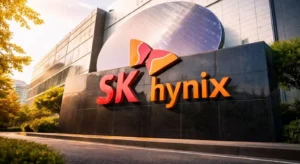

SK Hynix, the South Korean memory chip giant, is preparing for a major move into American financial markets. The company officially announced this week that it confidentially filed a Form F-1 document to launch a U.S. stock listing, targeting the second half of 2026. Experts believe this move could raise between $10 billion and $14 billion in new capital. While the company already trades on the KOSPI exchange in Korea, leadership clearly wants to tap into the deep pockets of American investors to fund their massive expansion projects.
The main goal of this listing is to close a long-standing “valuation gap.” Despite being a critical player in the global AI supply chain, SK Hynix stock has historically traded at a discount relative to its American rivals, such as Micron. Analysts believe the company’s primary listing in Seoul keeps its price lower than it deserves, given its massive production capacity. By listing in the United States, SK Hynix hopes to be judged alongside other global semiconductor giants, potentially driving up its stock price and making it more attractive to international fund managers.
Structural regulations in Korea slightly complicate the deal. SK Square, the largest shareholder of the chipmaker, must hold at least 20 percent of the company to satisfy Korean holding company laws. Fortunately, the math seems to work in SK Hynix’s favor. Analysts estimate that by issuing about 2 percent of new shares, the company can raise its desired $14 billion while allowing SK Square to maintain its ownership above the required 20 percent threshold. This strategy mirrors the success of other companies like TSMC, which often saw its U.S.-listed shares trade at a premium to its domestic price.
The move is already triggering a chain reaction across the entire Korean semiconductor sector. Investors are now putting intense pressure on Samsung Electronics to consider a similar path. Major shareholders, including Artisan Partners, argue that a U.S. listing would give American retail investors an easy way to buy the stock while simultaneously boosting the company’s overall valuation. If SK Hynix pulls off a successful listing, Samsung will likely face even stronger demands to follow suit, signaling a potential shift in how Korean tech giants approach global capital markets.
SK Hynix needs this mountain of cash to survive the “RAMmageddon” era. The world currently faces a severe shortage of high-bandwidth memory (HBM), an essential component powering modern AI systems from companies like Nvidia. CEO Noh-Jung Kwak recently stated that financial capacity remains the most important factor for growth. The company aims to build a net cash reserve of roughly $75 billion to support long-term investments. Without these funds, the company cannot possibly meet the skyrocketing demand for memory chips that experts expect to last until at least 2027.
The scope of the company’s upcoming projects is truly staggering. SK Hynix plans to invest roughly $400 billion by 2050 to build a massive semiconductor cluster in Yongin, South Korea. Beyond that, the company is actively constructing new facilities in Indiana and elsewhere in Korea, with total immediate spending in the billions. To keep these factories at the cutting edge, SK Hynix also signed a $7.9 billion deal this week with ASML to acquire advanced extreme ultraviolet lithography scanners. These machines are essential for producing the high-performance memory chips the AI industry demands.
While companies like Google try to solve memory shortages through software efficiency, such as their new “TurboQuant” algorithm, hardware remains the true bottleneck. The massive capital requirements for these chip factories explain why SK Hynix is chasing a blockbuster U.S. listing. By opening its doors to American capital, the company hopes to secure the future of its production lines. If this plan succeeds, the influx of billions of dollars will likely solidify SK Hynix’s position as a permanent leader in the global artificial intelligence economy.