
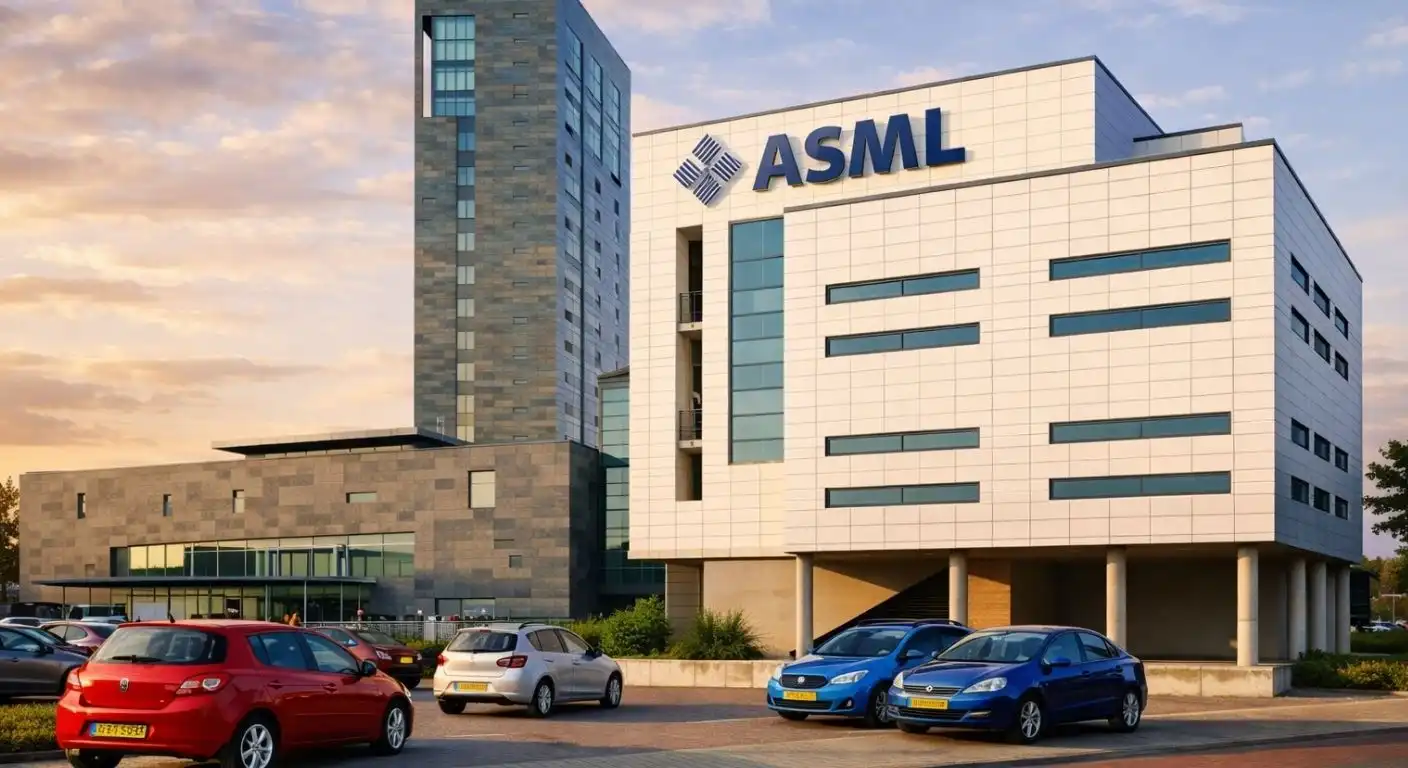
Every time you use Artificial Intelligence (AI), you are, in some small way, relying on ASML, a 42-year-old Dutch company with 44,000 employees. This company spends €4.5 billion annually to advance its technology, making the machines that create the chips essential for AI.
ASML, based in the Netherlands, holds a unique position: it builds the only machines in the world capable of printing the microscopic patterns on silicon wafers that form the most advanced semiconductors. This critical process is called extreme ultraviolet lithography, or EUV. These machines are massive, roughly the size of a school bus, take months to put together, involve hundreds of suppliers, and cost anywhere from $200 million to over $400 million each, depending on their generation. Even ASML’s biggest customers occasionally find these prices daunting.
This monopoly has made ASML the most valuable company in Europe, with a worth exceeding $530 billion. With the four largest American tech companies—Microsoft, Meta, Amazon, and Google—committing over $600 billion to AI infrastructure spending this year alone, demand for ASML’s machines has soared. The company has openly stated that the world will face a chip shortage for years to come.
Such high demand has also made ASML a target. Substrate, a San Francisco startup founded by a protégé of Peter Thiel, has raised over $100 million and is valued at more than $1 billion. Substrate claims it can build a rival lithography machine. Separately, there have been reports that former ASML engineers in China have partly reverse-engineered the technology, a prospect with huge global political implications.
Christophe Fouquet, who became ASML’s CEO in 2024 after working at the company for over ten years, spoke with this editor on Tuesday morning in Beverly Hills, before his appearance at the Milken Institute Global Conference. Dressed in a blue suit, he seemed relaxed, even when discussing competitors.
When asked if he anticipated the AI boom, Fouquet admitted, “No, not at all. We worked very hard, but not with the idea that this would come. You went from a concept — something people thought would eventually arrive — to ChatGPT, which was really the first good example of what AI could do. And now I think we look at AI as the next revolution, not only industrial but societal. Did I see it coming? No. Sitting in the middle of it every day, sometimes we wake up in the morning and still check that what is happening is really happening.”
Regarding whether the supply chain can keep up with demand, Fouquet said, “The demand is such that the market overall will be supply-limited for quite a bit. Right now, the biggest bottleneck seems to be in chip manufacturing. We, as an equipment supplier, follow our customers, and so far we’ve followed them pretty well — but we know we have to step up our entire supply chain and capacity. If you talk to the hyperscalers, I think they will tell you that for the next two, three, even five years, they’re not going to get enough chips.”
When asked about TSMC recently calling ASML’s latest machines too expensive, Fouquet responded, “An EUV system, if you look at the price, is going to be more expensive than a low-NA system, but the cost of making a wafer with this tool on some advanced layers will be cheaper. We can get 20%, 30% cost reduction.”