

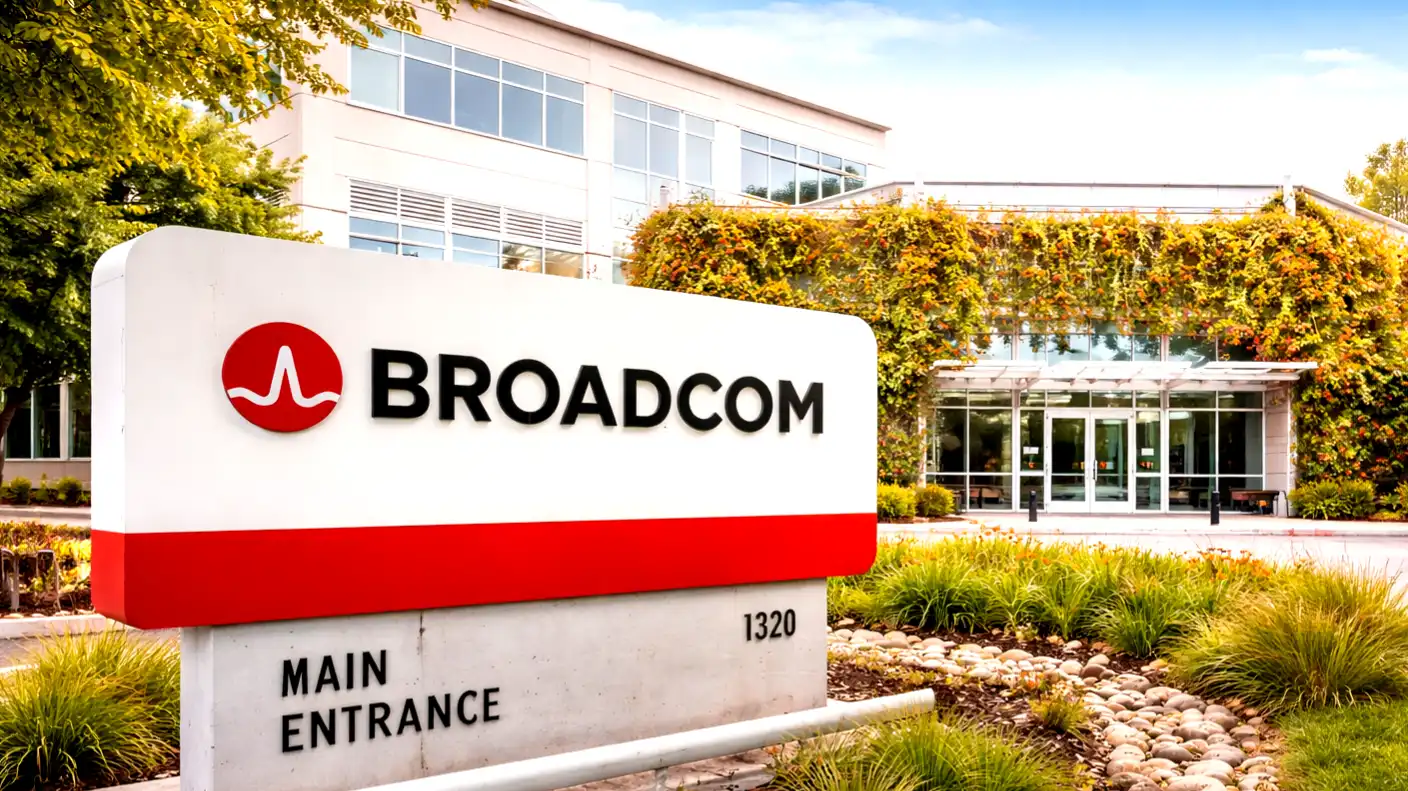
Wall Street faced a sharp reality check on Thursday, June 4, 2026, as a massive sell-off in the semiconductor sector brought a sudden end to an extended market rally. Investors, who had grown accustomed to record-breaking gains, turned cautious as major indices retreated, led by a double-digit percentage plunge in chip giant Broadcom.
The downturn followed Broadcom’s latest earnings report, which disappointed Wall Street despite the company’s strong financial history. Shares of the chipmaker tumbled by 13% during the session. The primary trigger for the decline was CEO Hock Tan’s decision to keep the company’s full-year AI chip revenue target at $100 billion rather than raising it to satisfy heightened investor expectations. While Broadcom reported adjusted earnings per share of $2.44, narrowly beating the $2.40 estimate, its revenue of $22.19 billion fell slightly short of the $22.27 billion consensus.
The cooling sentiment in tech extended beyond Broadcom, with cybersecurity firm Crowdstrike also experiencing a significant post-earnings slide. These developments pushed the Nasdaq Composite down by 0.89%, or 239.92 points, to close at 26,853.98. The broader S&P 500 followed suit, shedding 0.74% to settle at 7,553.68, while the Dow Jones Industrial Average dropped 1.21% to 50,687.07.
Market strategists note that this pullback may reflect natural consolidation after an aggressive two-month climb. Data from Deutsche Bank suggests the S&P 500 rose more than 16% over April and May, a surge of magnitude rarely seen since World War II. Comparisons are now surfacing between current market conditions and the months leading up to the 1987 crash, as the Case-Shiller P/E ratio sits at 42.53, levels not seen since the height of the dot-com bubble.
Despite the broader tech weakness, some areas of the market found room to grow. Consumer-oriented stocks caught a bid as energy prices and bond yields retreated. West Texas Intermediate crude oil fell $3.19, a 3.32% decline, settling at $92.83 per barrel. This relief in energy costs followed news that Israel and Lebanon had agreed to renew a fragile ceasefire, easing some of the geopolitical anxiety that had gripped investors earlier in the week.
All eyes are now turning toward Friday’s crucial economic data. Investors are preparing for the May nonfarm payrolls report, scheduled for release at 8:30 a.m. ET. Analysts expect the economy added 85,000 jobs, a figure that is historically light compared to the 115,000 jobs added in April. If these numbers hold, it would mark the third consecutive month of job growth, even as the unemployment rate remains projected at 4.3%.
While the sudden shift in momentum has rattled some traders, analysts at major financial firms suggest that short-term volatility is to be expected. Some research indicates that companies facing earnings pressure often cut back on weaker product lines, which can ironically lead to better long-term value for investors. As the market navigates these headwinds, the focus remains on whether corporate earnings can continue to justify high valuations in a shifting geopolitical and interest-rate environment.
For now, the era of unbridled optimism seems to be on pause. With Bitcoin also slipping by $1,555, or 2.41%, to reach $63,985, risk assets across the board are feeling the pressure. Investors will likely remain in “wait-and-see” mode until the Friday jobs report provides more clarity on the health of the U.S. labor market and the potential path for future economic activity.