
Just over a decade ago, the fastest part of your computer—the processor—spent most of its time waiting. It was waiting for a slow, clunky, mechanical device to find the data it needed. That device was the hard disk drive, and its whirring platters were the single biggest bottleneck in modern computing. Then, the solid-state drive (SSD) arrived and changed everything. It was a silent revolution that made our computers feel instantly alive. But that revolution is far from over. The future of storage isn’t just about getting faster; it’s about getting smarter.
The Era of ‘More’: Faster, Denser, Cheaper
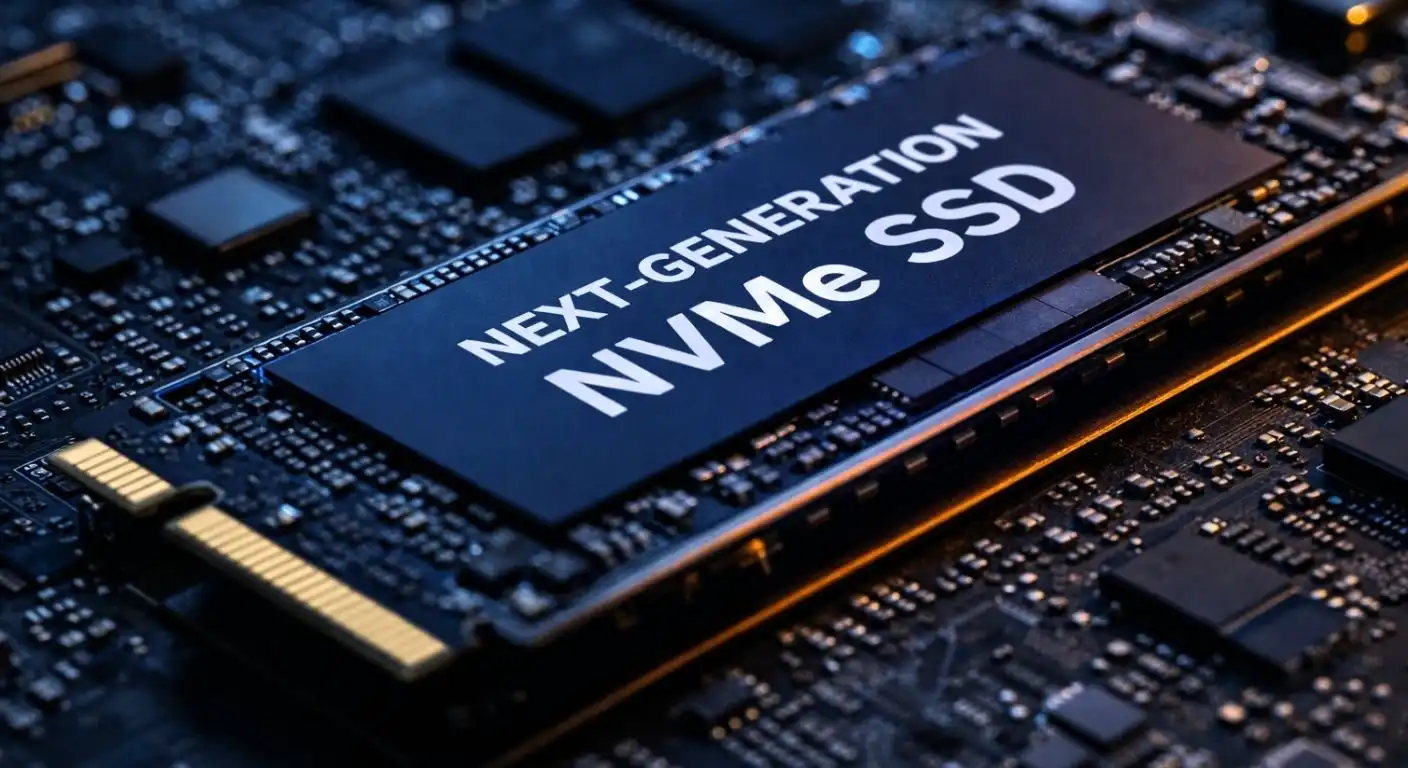
The most obvious path for the future of SSDs is the one we’re already on: more of everything. We are in a relentless race to make flash memory faster, denser, and cheaper. New connection standards are opening up data firehoses that are wider than ever before, allowing us to transfer massive files in the blink of an eye. At the same time, engineers are figuring out how to stack memory cells in 3D, cramming an astonishing amount of storage into a tiny chip. The days of a one-terabyte drive being a luxury are numbered. Soon, that will be the baseline, and our ability to store vast libraries of games, movies, and data will be taken for granted.
The Drive That Thinks: Computational Storage
This is where the future gets truly exciting. For decades, the storage drive has been a dumb warehouse. The main brain of the computer (the CPU) had to ask for a huge pile of books from the warehouse, read through them all to find the right sentence, and then put the books back. “Computational storage” flips this idea on its head. It puts a small brain inside the warehouse. Instead of moving all the data, the drive itself can perform simple tasks like searching, filtering, or compressing. The CPU can just ask the drive for the right sentence, and the drive delivers it. This is a massive leap in efficiency that will be a game-changer for data centers and AI.
Beyond Flash: The Next Generation of Memory
The NAND flash memory that powers today’s SSDs is a brilliant technology, but it has its limits. It wears out over time. Scientists and engineers are already working on what comes next. A new class of “storage-class memory” technologies is on the horizon. These have exotic names like Phase-Change Memory (PCM) or MRAM, but they share a common, magical goal: to be as fast as your computer’s main memory (RAM) but with the ability to store data permanently, even when the power is off.
The Blurring Lines Between Memory and Storage
This new generation of memory leads to the most profound change of all: the end of the distinction between storage and memory. Right now, your computer has fast, temporary memory (RAM) and slower, permanent storage (your SSD). In the future, these two things could merge into a single, unified pool of ultra-fast, persistent memory. Imagine a computer that has no “boot-up” time because its memory is never erased. You could turn it off in the middle of a complex project, and when you turn it back on a week later, everything would be exactly as you left it, instantly.
From Dumb Box to Active Partner
The evolution of storage is a journey from a slow, mechanical box to a silent, instant one. The next phase of that journey will transform it from a silent partner into an active, intelligent one. The future of storage is not just about holding our data; it’s about helping us process it. It’s a future that is not only faster, but smarter, more efficient, and so seamless that the drive itself might just disappear into the background entirely.