

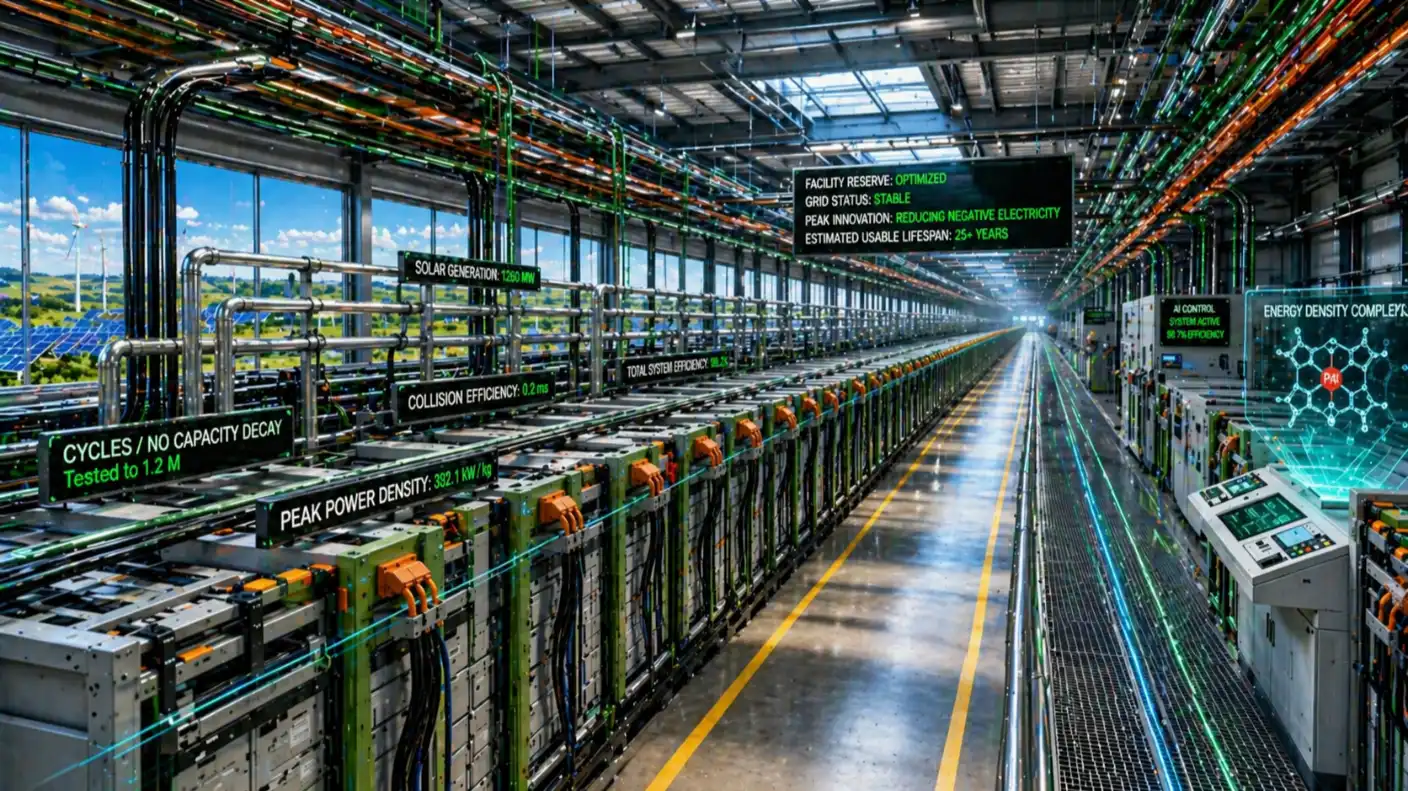
Researchers in China say they have made a big step forward with iron-based flow batteries. This could cut the cost of storing renewable energy and make batteries last much longer. The team, from the Institute of Metal Research at the Chinese Academy of Sciences, created a new electrolyte design. This allowed an alkaline all-iron flow battery to complete over 6,000 cycles without losing any noticeable storage capacity, according to their findings in Advanced Energy Materials.
Scientists have studied iron flow batteries for years, but they often had stability issues that limited how long they could be used. The active materials inside the battery tended to break down or leak through membranes, which made them less efficient and shortened their life.
The researchers fixed these problems by changing the molecular structure of the negative electrolyte in the system. The team made 11 different iron compounds from 12 organic parts. They found one compound, called [Fe(HPF)BHS]⁴⁻, to be the most stable. Its large structure creates a physical shield around the iron core. At the same time, negatively charged parts help stop unwanted reactions and reduce material leaking across the membrane.
Tests showed the battery running at 80 mA·cm⁻² for over 6,000 cycles with no loss of capacity. It also had an average coulombic efficiency of 99.4%, based on the performance data released by the research team. Under higher current conditions, the system reached a peak power density of 392.1mW·cm⁻². It still kept an energy efficiency of 78.5%, showing it performs well even under heavier electrical demand.
Researchers linked the high cycle count to long-term use. They estimated this performance is like more than 16 years of daily use without any noticeable decline. Iron is over 80 times cheaper than lithium as a raw material. If this technology can be scaled up successfully, it could make large-scale energy storage much less expensive.
Iron is also very common, being one of the most abundant metals on Earth. This reduces worries about supply shortages, unlike with lithium. All-iron flow batteries use water-based electrolytes instead of the flammable liquids found in lithium-ion systems. This chemistry removes the conditions that can lead to “thermal runaway,” a chain reaction that can cause battery fires or explosions.
Storing energy on a large scale remains one of the biggest technical hurdles for expanding renewable energy, as electricity from solar and wind changes with weather conditions. This research improves the stability of iron-based electrolytes. However, real-world testing outside controlled labs will show how well this chemistry actually works in actual grid installations.